Public Phone: The use of the public phones seemed more random than not. They were hard to spot and once you did, there was nothing rewarding about them.
Questions with Ideas: Why was the phone number always the same? What could the user discover on each individual public phone? What was the difference between using a public phone or a cell-phone? ? Could the use of cell-phones be further explored; as in being able to tag spaces? What would happen if the public phone would actually ring for users to answers?
Walk + Spatial Context: The idea of layering urban space with its past was a great idea but completely unsuccessful. The idea of walking through a space with “new eyes” was not well explored and the spatial seemed to lack the right context. To successfully integrate urban space into a new context the viewer has to be submerged into an experience that alters in someway or another there senses to experience something new and different that layers, as a collage does, over what is already “known”.
Questions with Ideas: How can the user be submerged into an experience through walking? Can surprise change a context?
See: AngelProject,
Memory of the City News.Box.Walk Surprise: This project lacked the crucial element of surprise. The most obvious way that this could be integrated is through a “scavenger hunt” type of interaction that can lead to a special narrative.
Questions with Ideas: Is discovery necessary for surprise? How can a narrative be constructed through discovery?
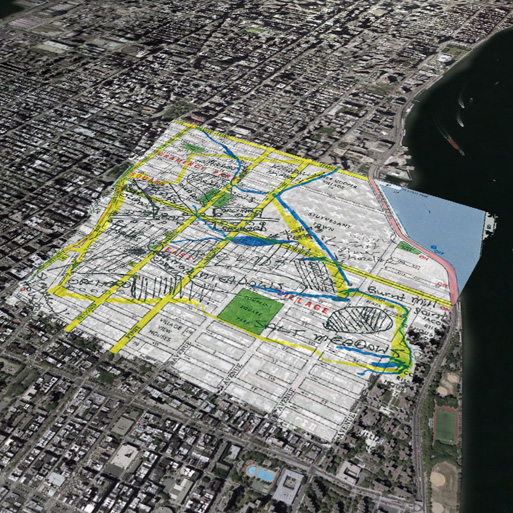
Map: Even though the idea of having a downloadable map was very successful, the idea of urban mapping today, opens a lot more possibilities.
Questions with Ideas: Can the map be tagged and thus altered? Can the user input something to the experience that changes it? Can the map be downloadable for a cell phone? How will the map for a cell phone user differ from that of the public-phone user?
See: SoundseekerCodes: The use of the numbers of the codes (1,2,3,etc) was extremely arbitrary limiting the narrative to a lineal one. Giving out the codes for each sound on the map immediately resulted in a lack of involvement of the viewer.
Questions with Ideas: What are codes? What happens if the user has to discover the codes? If one code leads to the other? How can the codes be attached to a specific public-phone? What relation does the number of each code have to the sound or the place or the experience? Can the codes be attached to the map in some other way other than just as a label?
Sounds: The sounds were extremely low quality and some seemed they had nothing to do with the specific place they were supposed to be heard at.
Questions with Ideas: Did it make a difference if I heard one sound in one place or another? Was the use of the medium (phones) considered when creating the sounds? How important is the quality of sound when using it as an experience?
See: Her Long Black Her
Website: The website was the strongest part in this whole project. Having a map that could be downloadable by anyone was very interesting to me as it immediately opened up the possibilities of new audiences. As well, it enabled anyone to distribute the tour (through email, etc). I specifically enjoyed the sketched out map over the GoogleEarth image and reading where the idea for the tour came from. Questions with Ideas: Would this project benefit from a website with dynamic contents? With the user being able to upload changed maps, comments, tags etc?
See: Yellow Arrow